
Bookkeeping & accounting
Income in, expenses out, and the reports an accountant actually asks for. For sole proprietors and small businesses keeping their own books, who want a clean P&L and a year-end summary without learning accounting software first.
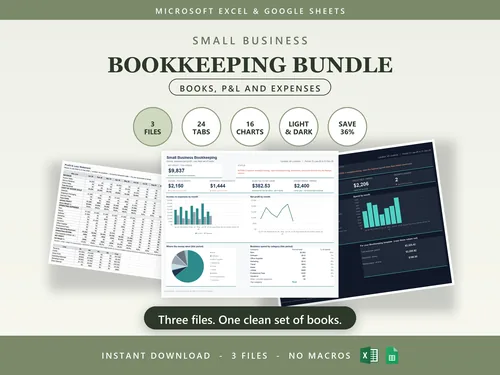
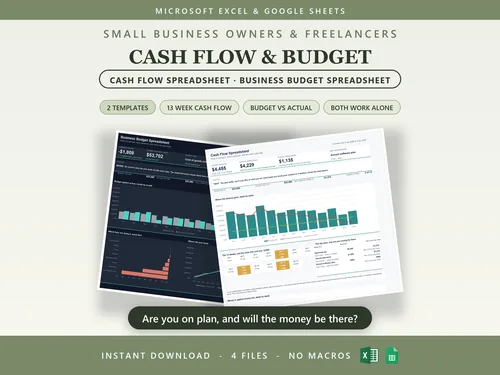
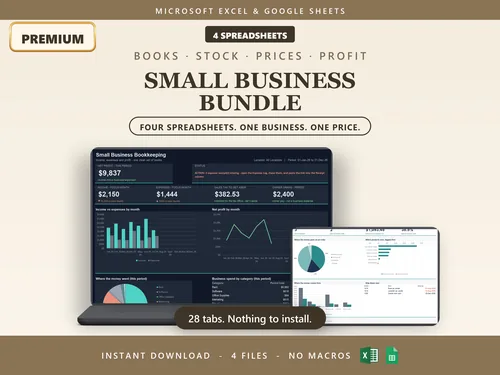
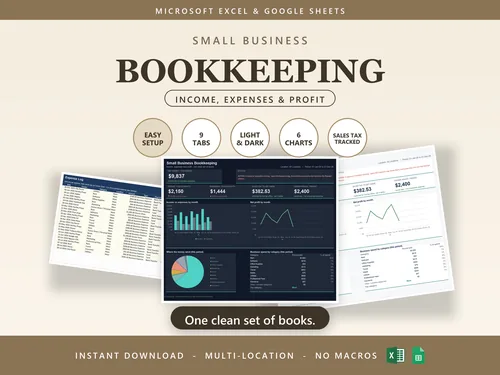
None of these replace an accountant. They hand one a tidy profit and loss and sorted expenses to work from, which leaves them less to untangle.
The templates side by side
Every one works in Excel and Google Sheets. "You type into" counts the tabs where your numbers go; "calculated for you" counts the tabs that need no typing at all, and "set up once" the tabs you fill in at the start.
| Template | Tabs | You type into | Calculated for you | Set up once | Price |
|---|---|---|---|---|---|
| Small Business Bookkeeping (Income/Expense) | 9 | 3 | 4 | 2 | $4.79 |
| 1099 / Schedule C Self-Employed Tax Spreadsheet | 9 | 2 | 5 | 2 | $3.80 |
| S-Corp Reasonable Salary & Distribution Optimizer (US) | 8 | 1 | 5 | 2 | $8.69 |
| Mileage Tracker | 8 | 2 | 4 | 2 | $2.81 |
| Business Budget Spreadsheet | 6 | 2 | 2 | 2 | $3.29 |
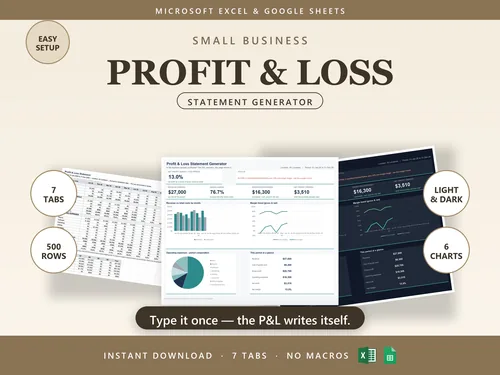
| Profit & Loss Statement Generator | 7 | 2 | 3 | 2 | $3.80 |
| Pricing Calculator | 7 | 2 | 3 | 2 | $4.49 |
| Inventory Tracker | 6 | 2 | 2 | 2 | $2.69 |
| Employee Timesheet | 6 | 2 | 2 | 2 | $3.29 |
| Invoice Tracker & Generator | 8 | 3 | 3 | 2 | $2.99 |
| Cash Flow Spreadsheet | 8 | 4 | 2 | 2 | $3.29 |
| Employee Attendance and PTO Tracker | 6 | 2 | 2 | 2 | $3.29 |
| Client Tracker & CRM | 7 | 2 | 3 | 2 | $5.69 |
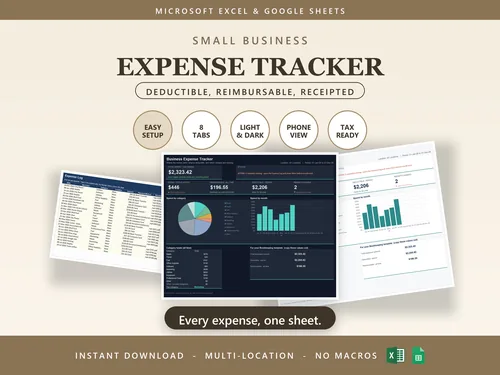
| Business Expense Tracker | 8 | 2 | 4 | 2 | $1.79 |
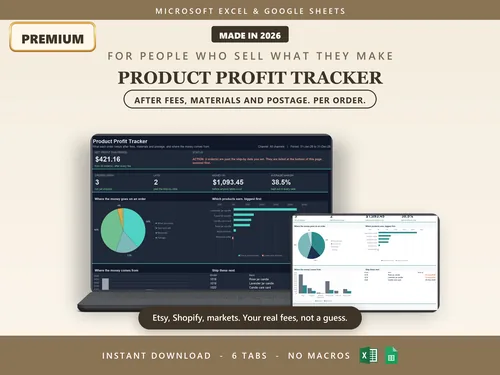
| Product Profit Tracker | 6 | 1 | 2 | 3 | $2.69 |
Which template do I need?
Bookkeeping starts with a log you will actually keep. Income and expenses in one file, building a monthly P&L is the core of it, and a receipt and expense log is the cheapest way in.
When the books need to produce something, a clean P&L from your own logs is the report accountants ask for. The four-file bundle adds stock, pricing and per-order profit for a product business, and the starter pack is the smaller three-file version.
If the month-end itself is the problem rather than the numbers, separating the weekly cash question from the annual budget question usually is the fix.
What to keep, and for how long
The IRS asks you to keep the records behind your return for 3 years from the date you file it. That stretches to 6 years if income you left off was more than a quarter of what you reported, and employment tax records have to be kept for at least 4. (IRS: how long to keep records)
Most sole proprietors keep their books on the cash method: income counts on the day it arrives and an expense on the day you pay it. That makes the bank statement your best check. If the month in your log and the month on the statement end on different balances, something is missing from one of them.
A separate bank account is not a legal requirement for a sole proprietor, but it is the single change that makes bookkeeping quicker, because every line on that statement is business.