
Break-Even Calculator
Find the point where your sales finally cover your costs, worked out across everything you sell rather than one product at a time.
Updated 30 October 2026.
This is a free break-even calculator that works across several products at once. Most free ones assume you sell a single thing at a single price. This one takes your real sales mix and tells you the units and the revenue you need, in total and product by product.
- Several products, not one. The answer depends on which of them sell.
- Units and revenue. In total, and split across the range.
- Cushion. How far current sales sit above the line, if you know them.
Where you break even
Sales needed
Example: 136 sales a month
Money in against money out as sales climb. Red hairlines are a loss, green a profit, and the dot is where one becomes the other.
HAIRLINE LINE · ONE HAIRLINE = THE GAP AT THAT MANY SALES
How that splits across what you sell
Sales of each product needed to break even at this mix.
RUNG BARS · UNITS TO SELL, PRODUCT BY PRODUCT
| Product | Price | Cost per sale | Left over | Share of sales | Units to sell | Revenue |
|---|
An estimate from the figures you gave. It assumes your sales keep roughly the same mix and that your costs hold. Real months rarely behave, which is why the number is a target to steer by rather than a promise.
New to this? Read a short explanation first
Break-even is the point where the money coming in finally covers the money going out. Below it you are paying for the privilege of trading. Above it, every sale starts adding to profit rather than filling a hole.
Two kinds of cost decide where that point sits. Fixed costs stay the same whether you sell one thing or a thousand: rent, insurance, a software subscription, a market stall booked for the month. Variable costs happen once per sale: materials, packaging, shipping, the slice the platform takes.
The gap between what you charge and what a sale costs you is what is left over to pay the fixed costs with. Accountants call it contribution. Once enough of those gaps have added up to cover the fixed costs, you have broken even, and everything after that is profit.
Most calculators stop at a single product, which is fine if you sell one thing. If you sell fourteen at different prices and different margins, the answer depends on which ones people actually buy. A month of cheap items and a month of expensive ones break even at very different volumes. So this asks roughly how your sales divide between products, and works the number out for that mix.
You do not need exact figures to get something useful. A reasonable guess at the mix, and honest costs, will tell you far more than an exact calculation of a single product you happen to have to hand.
Read more on pricing and inventory: markup, margin and when to reorder, and the templates for it.
The Break-Even Calculator above finds the number. Something has to watch it.
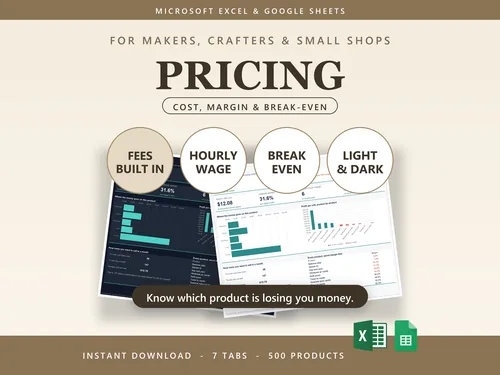
Pricing Calculator
A break-even figure is only true for the costs and the mix you fed it. Prices drift, a supplier puts materials up, and one product quietly becomes most of what you sell. The number moves and nothing tells you.
It holds the costs and prices behind these figures, and flags anything trading below the margin you wanted. The Inventory Tracker keeps the stock side, and the Product Profit Pack is both. Excel and Google Sheets, nothing locked.
Questions people ask
What is the difference between a fixed and a variable cost?
A fixed cost arrives whether or not you sell anything: rent, insurance, a subscription, a pitch booked for the month. A variable cost only happens because a sale happened: materials, packaging, shipping, the platform's fee. The quick test is to imagine a month where you sold nothing and ask which bills still turn up. Those are the fixed ones.
Why does selling several products change the answer?
Because each one leaves a different amount behind after its own costs. A month heavy on your cheapest item breaks even at a very different volume from a month heavy on your dearest. Working from a single product, or from an average price with no mix behind it, gives a number that is right for a business you do not have.
What if I do not know my sales mix?
Guess, and lean toward what you know sells. The shares do not need to be exact or to total a hundred, because whatever you enter is scaled to fit. A rough mix with honest costs is far more useful than a precise calculation of one product picked because its figures were handy.
One of my products shows a warning. What does that mean?
It is priced at or below what each sale costs you, so it contributes nothing toward your fixed costs. Every one you sell makes the hole slightly deeper. No volume fixes that, which is why the calculator names it rather than quietly working around it. Either the price goes up or the cost comes down.
What is the cushion figure?
It is how far your current sales sit above the break-even line, as a percentage. Accountants call it the margin of safety. A cushion of 30 percent means sales could fall by nearly a third before you start losing money. A small cushion is not a crisis, but it tells you how little room a quiet month leaves you.
Does this include tax?
No. It works in the money that passes through the business, before income tax or corporation tax on any profit. If you collect sales tax and pass it straight on, leave it out of your prices here, because it was never yours.