
PTO Accrual Calculator
See your paid time off on any date, the hours a cap or carryover limit will take, and what your balance is worth if you leave.
Updated 30 October 2026. Rules checked 1 October 2026.
The PTO Accrual Calculator is a free tool for employees who earn paid time off each paycheck, per hour worked, or all at once each year. It projects your balance payday by payday, shows when a cap stops you earning more, and works out what the hours are worth.
- Hours you are about to lose. The date you hit your cap, the hours never credited after it, and anything over your carryover limit at year end.
- What it is worth. Your balance in dollars, and what a payout is commonly worth after withholding.
- Your state's rule. Whether your state requires unused vacation to be paid when you leave, with the source.
Whatever you type here is not saved or sent anywhere. We never see it, and it is gone when you close the page. Every figure follows your employer's policy, so the numbers come from your handbook or pay stub. State rules are shown with their source, as information rather than legal advice. Paid sick leave required by state or city law is separate and not counted here.
Your PTO
Balance
Your balance month by month. The dashed line is your cap; red marks hours you lose to it or at the year-end rollover.
HAIRLINE · BALANCE AT EACH MONTH END
If you left on that date
Federal withholding on a separate payout is commonly a flat 22%, plus 6.2% Social Security and 1.45% Medicare (IRS Publication 15, 2026). Withholding is not the final tax: what you owe is settled on your return, so some of it may come back.
Month by month
| Month ending | Earned | Used | Lost to cap | Lost at rollover | Balance |
|---|
How is PTO accrual calculated?
Divide the time off you get in a year by the number of paychecks. Fifteen days at eight hours is 120 hours; paid every two weeks, that is 26 paychecks, so you earn 4.62 hours each payday. Paid monthly it is 10 hours a month, and paid by the hour it is 0.058 hours for every hour you work, or 1 hour for every 17.3.
| Per year | Hours | Every two weeks | Twice a month | Per hour worked |
|---|---|---|---|---|
| 10 days | 80 | 3.08 | 3.33 | 0.0385 |
| 15 days | 120 | 4.62 | 5.00 | 0.0577 |
| 20 days | 160 | 6.15 | 6.67 | 0.0769 |
| 25 days | 200 | 7.69 | 8.33 | 0.0962 |
The per-hour column assumes a full-time year of 2,080 hours. Part-time staff on a per-hour policy earn the same rate on fewer hours, so the calculator takes the hours you actually work.
Why did my PTO stop going up?
Almost always a cap. Many policies set the most you can hold, often one and a half to two times what you earn in a year. Once you reach it, each payday's accrual is simply not credited until you take time off and drop below the cap again. Nothing tells you this is happening: the balance just stays still. Someone earning 80 hours a year who sits at a 120-hour cap for six months has missed about 40 hours, a full week of paid time off.
Why did my balance drop on 1 January?
That is a carryover limit, the year-end version of use-it-or-lose-it. Anything above the limit is removed when the plan year starts again. A cap and a carryover limit are different rules, and many policies have both. California, Colorado, Montana and Nebraska do not allow earned vacation to be forfeited this way, though a cap is allowed. Choose your state below the tool to see its rule.
Do I get paid for unused PTO when I quit?
It depends on your state, then on your employer's written policy. California, Colorado, Illinois, Louisiana, Massachusetts, Montana, Nebraska and North Dakota require earned vacation to be paid when you leave; Maine does at employers with 11 or more staff, and Rhode Island after a year of service. Indiana, Maryland, New York, North Carolina, West Virginia and Wisconsin require it unless a written policy you were told about says otherwise. Everywhere else the policy decides. Each state's rule above links to its statute or labor department.
Sources, checked 1 October 2026: each state's statute or labor department page, linked in the state result; Paycor's and Rippling's 2026 state charts for states without a statute; IRS Publication 15 (2026) for withholding. Where a payroll chart disagreed with the state's own guidance, the state's guidance is used. This is general information, not legal advice.
New to this? Start here
Find three numbers first. Your yearly allowance (offer letter or handbook), your current balance (pay stub or HR portal), and any cap or carryover limit (the handbook's PTO section, often under "maximum accrual" or "rollover").
Pick how you earn it. Most employers add a set amount each paycheck. Hourly and part-time staff often earn per hour worked. Some employers grant the whole year on day one, called front-loading.
Read the answer. The big number is your balance on the date you chose. Under it, red means hours you are losing: to the cap while you sit at it, or at the year-end rollover. If either appears, booking time off before that date keeps those hours.
Leaving soon? Add your hourly pay and state. You will see what the balance is worth, what is commonly withheld from a payout, and whether your state requires the payout at all.
Read more on hours, overtime and leave: what federal law asks of an employer, and the templates for it.
The PTO Accrual Calculator above works out one person's balance. Running a team means doing it for everyone, every payday.
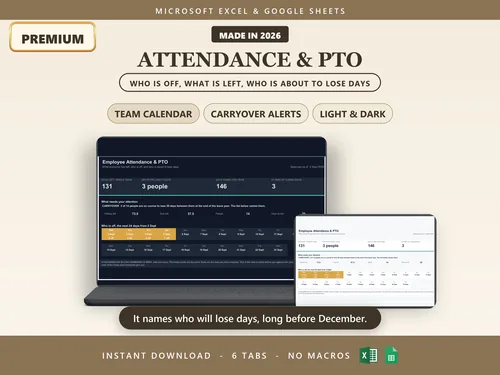
Employee Attendance and PTO Tracker
Each employee's yearly allowance, carryover cap and whether their leave is front-loaded are set once. Time off is logged against the balance, and the dashboard shows days left across the team and who is at risk of losing days before the year turns.
Related
To total the hours you worked from clock-in and clock-out times, use the Time Card Calculator. If your PTO accrues per hour worked, overtime hours may count too, depending on the policy: the Overtime Calculator settles each week.
PTO payout laws by state
Whether unused vacation or PTO is paid when you leave depends on your state first, then on your employer's written policy. 10 states require the payout, 6 require it unless a written policy says otherwise, and the rest leave it to the employer. Each state in the table was checked on 1 October 2026 against its own statute or labor department page; for the states listed under it, the Paycor and Rippling 2026 state charts agree there is no law. Paid sick leave laws are separate and not listed here.
| State | Paid when you leave? | Use-it-or-lose-it | What the law says |
|---|---|---|---|
| California | Yes, required | Not allowed (a cap is) | Cal. Labor Code 227.3. Earned vacation is wages and is paid at the final rate of pay whatever the reason for leaving. A reasonable cap on the balance is allowed. Source |
| Colorado | Yes, required | Not allowed (a cap is) | C.R.S. 8-4-109 and Nieto v. Clark's Market (2021). All earned vacation is paid on separation and cannot be forfeited; a cap on accrual is allowed. Source |
| District of Columbia | Employer's policy decides | No state rule | The employer's policy or contract decides whether earned vacation is paid on leaving (Paycor 2026). |
| Illinois | Yes, required | Only with notice | 820 ILCS 115/5. Earned vacation is paid on leaving. A use-it-or-lose-it rule is allowed only if employees know of it and have a fair chance to use the time. Source |
| Indiana | Yes, unless a written policy says otherwise | No state rule | Indiana treats accrued vacation pay as compensation; the employer's written policy decides whether it is forfeited on leaving. Source |
| Louisiana | Yes, required | No state rule | La. R.S. 23:631. Vacation pay the employee is eligible for and has accrued is paid on discharge or resignation. Source |
| Maine | Yes, required | No state rule | 26 MRSA 626. Unused paid vacation accrued from 1 January 2023 is paid on leaving, at employers with 11 or more employees. Source |
| Maryland | Yes, unless a written policy says otherwise | No state rule | Md. Lab. & Empl. 3-505. Accrued leave is paid on termination unless the employer has a written policy that limits it and told the employee. Source |
| Massachusetts | Yes, required | Only with notice | M.G.L. c.149 s.148 (Attorney General advisory). Earned vacation is wages and is paid in the final paycheck. Caps and use-it-or-lose-it need fair notice. Source |
| Minnesota | Employer's policy decides | No state rule | The employer's policy or contract decides whether earned vacation is paid on leaving (Paycor 2026). |
| Montana | Yes, required | Not allowed (a cap is) | Once vacation is earned under the employer's policy it is wages and is paid like other wages (Montana Department of Labor, Attorney General Opinion 23-56). Plans called PTO rather than vacation can differ. Source |
| Nebraska | Yes, required | Not allowed (a cap is) | Neb. Rev. Stat. 48-1229. Earned but unused vacation, and PTO that can be used as vacation, is wages owed on separation. Source |
| New Hampshire | Employer's policy decides | No state rule | RSA 275:43 V. Vacation pay is wages when the employer's practice or policy makes it due, so the policy decides. Source |
| New Mexico | Employer's policy decides | No state rule | New Mexico DWS: unused PTO may be payable on separation according to the employer's PTO policy. (One payroll chart lists New Mexico as required; the state's own guidance does not.) Source |
| New York | Yes, unless a written policy says otherwise | Only with notice | N.Y. Labor Law 198-c. Vacation is paid on leaving unless the employer told employees in writing of the conditions under which it is forfeited. Source |
| North Carolina | Yes, unless a written policy says otherwise | Only with notice | G.S. 95-25.12. Earned vacation cannot be forfeited unless a written forfeiture policy was given to employees. Source |
| North Dakota | Yes, required | Only with notice | N.D.C.C. 34-14-09.2. No contract or policy may forfeit earned paid time off on separation. (A payroll chart limits this to involuntary separations; the state does not.) Source |
| Ohio | Employer's policy decides | No state rule | No Ohio statute; Ohio courts have treated earned vacation as owed unless the employer's policy says otherwise (Paycor 2026). |
| Rhode Island | Yes, required | No state rule | R.I. Gen. Laws 28-14-4. Accrued vacation becomes wages on separation once the employee has completed at least one year of service. Source |
| West Virginia | Yes, unless a written policy says otherwise | No state rule | W. Va. Code 21-5-1. Accrued vacation is a fringe benefit counted as wages, paid on leaving unless a written agreement with employees says otherwise. Source |
| Wisconsin | Yes, unless a written policy says otherwise | No state rule | Wisconsin DWD: if the employer has a written vacation policy without a written forfeiture rule, earned unused vacation is paid. Source |
No state law, so the employer's policy decides (30 states): Alabama, Alaska, Arizona, Arkansas, Connecticut, Delaware, Florida, Georgia, Hawaii, Idaho, Iowa, Kansas, Kentucky, Michigan, Mississippi, Missouri, Nevada, New Jersey, Oklahoma, Oregon, Pennsylvania, South Carolina, South Dakota, Tennessee, Texas, Utah, Vermont, Virginia, Washington, Wyoming.
Where the payroll charts disagree: one widely used chart lists New Mexico as requiring payout, but New Mexico's own guidance leaves it to the employer's policy. Another limits North Dakota's rule to people who are let go, but North Dakota's law covers anyone leaving. This table follows the states. It is general information, not legal advice.
Questions people ask
How do I calculate my PTO accrual rate?
Divide your yearly PTO hours by the number of paychecks in a year: 52 weekly, 26 every two weeks, 24 twice a month or 12 monthly. Fifteen days of eight hours is 120 hours, which is 4.62 hours every two weeks. For an hourly rate, divide the yearly hours by the hours you work in a year: 120 over 2,080 is 0.0577 hours per hour worked.
What is a PTO accrual cap?
The most PTO your employer lets you hold at one time. Once your balance reaches it, you stop earning more until you use some. Hours that would have been earned while you sat at the cap are not added later. A cap is allowed in every state, including those that ban use-it-or-lose-it.
Is use-it-or-lose-it PTO legal?
In most states, yes, if your employer's policy says so. California, Colorado, Montana and Nebraska do not allow earned vacation to be forfeited, though they allow a cap on the balance. Some other states, including Illinois, Massachusetts, New York and North Carolina, allow it only with clear notice and a fair chance to use the time.
Do I get paid for unused PTO when I quit?
In California, Colorado, Illinois, Louisiana, Massachusetts, Montana, Nebraska and North Dakota, earned vacation must be paid when you leave. Maine requires it at employers with 11 or more staff and Rhode Island after one year of service. Several other states require it unless a written policy says otherwise. Elsewhere your employer's policy decides.
How much tax is taken from a PTO payout?
Paid as part of a normal paycheck, it is withheld like regular wages. Paid separately, federal withholding is commonly a flat 22%, plus 6.2% Social Security and 1.45% Medicare, and your state may withhold too. That is withholding, not the final tax: what you actually owe is worked out on your tax return.
What does front-loaded PTO mean?
Your whole year's PTO is added on one date, usually the start of the plan year, instead of building up each paycheck. You can use it straight away. If you leave partway through the year, some policies only count the part you had earned by then.
How many hours is 3 weeks of vacation?
120 hours for a full-time employee: 3 weeks of 5 eight-hour days. Four weeks is 160 hours.
Paid every two weeks, 120 hours a year accrues at 4.62 hours a paycheck, and 160 hours at 6.15. If you work part time, a week means your usual week, so 3 weeks at 24 hours a week is 72 hours.
How do I calculate my PTO payout?
Multiply your unused hours by your hourly rate. If you are salaried, your hourly rate is your yearly salary divided by 2,080.
52 hours at $24 an hour is $1,248 before tax. Withheld at the common 22% federal rate plus 7.65% for Social Security and Medicare, about $878 reaches you before any state tax.
What is the average PTO accrual rate?
There is no single average, because it rises with years of service. In 2026, the most common allowance for private industry workers after one year was 10 to 14 days of paid vacation, and after 10 years, 15 to 19 days (Bureau of Labor Statistics).
10 days a year is 3.08 hours each biweekly paycheck; 15 days is 4.62.
Is there an Excel formula for PTO accrual?
Yes. The hours earned each paycheck are the yearly hours divided by the number of paychecks, so =120/26 for 120 hours paid every two weeks.
A running balance with a cap is =MIN(cap, previous balance + accrued - used), filled down one row per payday. That is the core of what this calculator does, plus the carryover limit at the end of the plan year.