
Debt Payoff Calculator
Enter what you owe. See the month you are debt free, what the interest costs you, and exactly what paying a little extra buys.
Updated 30 October 2026.
This is a free debt payoff calculator that compares three orders of attack against the do-nothing baseline of paying the minimums only. It handles percentage minimums and zero percent cards, and it names any debt whose minimum is too small to ever clear it. Nothing you type is sent to us or anywhere else, so we never see it.
- Avalanche puts every spare dollar at the highest interest rate first. Cheapest overall.
- Snowball puts it at the smallest balance first. Slower, but the first win comes sooner.
- Your own order respects the debt you want gone for reasons that are not arithmetic.
Your plan
Debt free on
What you still owe, month by month. The dashed line is the same debts on the minimums only.
HAIRLINE AREA · ONE HAIRLINE = ONE MONTH · DOT = A DEBT CLEARED
Avalanche or snowball
When each debt clears under the two orders. Hollow is snowball, ink is avalanche, and each bead between them is one month.
DUMBBELL QUEUE · ONE BEAD = ONE MONTH
The same debts, four ways
| Approach | Debt free | Months | Interest | Against minimums only |
|---|
Order you clear them
Show the full month-by-month schedule
| Month | Paid | Interest | Off the balance | Still owed | Target |
|---|
An estimate, not a promise. It assumes you keep paying, you borrow nothing new, and the rates hold. Card issuers round differently and some charge fees this does not know about, so treat the date as the right month rather than the right day.
Read more on personal finance: where to start with a budget, and the templates for it.
The Debt Payoff Calculator above plans the payoff. Something has to track it.
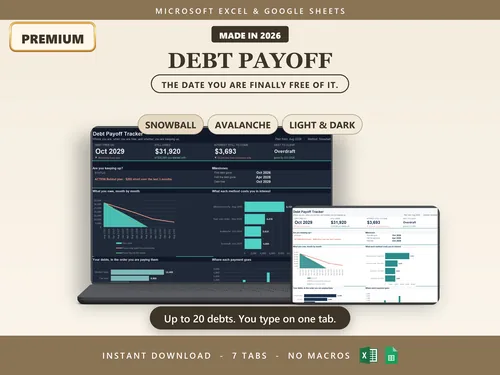
Debt Payoff Tracker
A calculator answers the question once. The hard part is the eighteen months afterwards: logging what you actually paid, watching the real balance against the plan, and seeing the date move when you miss a month or throw a windfall at it.
Same three orders of attack, plus a payments log, a running dashboard, and a payoff plan that updates as you go. It works in Excel and in Google Sheets, and nothing is locked behind a password.
Questions people ask
Which is better, snowball or avalanche?
Avalanche always costs less, because it kills the most expensive interest first. Snowball clears a whole account sooner, which for a lot of people is the difference between finishing the plan and abandoning it. Put your own numbers in above and the table shows you what the choice costs in your case. If the gap is small, take the one you will actually stick to.
What if my minimum payment is a percentage of the balance?
Type it as a percentage in the minimum payment box, like 2%, and the calculator recalculates the minimum every month as the balance falls. Most cards work this way, and most free calculators assume a fixed sum instead, which makes payoff look faster than it is.
What happens if a minimum payment does not cover the interest?
The balance grows every month and the debt never clears on its own. This is a real situation and the calculator names the debt when it spots it, rather than quietly producing a date that cannot happen. The fix is to target that debt first, whatever the order says.
Does a zero percent card break it?
No. A zero percent balance accrues no interest, so avalanche puts it last and snowball may put it first if it is small. The calculator handles it either way. Do bear in mind that a promotional rate ends, and this does not know your end date.
Do you store any of this?
No. The calculator works out your numbers on your own device. Nothing you type is sent to us or shared with anyone, so we have no way of seeing it. To save you retyping, it remembers your last plan in this browser on this device only, and clearing your browser data removes it. There is no sign-up and no email box on this page. If you want to come back to a plan, use the copy link button and keep the link.
Is this financial advice?
No. It is arithmetic on figures you supply. It cannot see your circumstances, and it does not know whether clearing debt or building an emergency fund matters more for you right now. For advice about your own situation, speak to a qualified adviser.
How long will it take to pay off my credit card?
It depends on three numbers: the balance, the interest rate and what you pay each month. $5,000 on a card at 22% APR, paid at $200 a month, takes 34 months and costs about $1,750 in interest. If your card sets the minimum as a percentage of the balance, type it as a percentage, like 2%, and the payoff date accounts for the minimum shrinking.
Each month the card adds interest of the balance times the APR divided by 12, and only what is left of your payment comes off the balance. That is why a small payment can take years. Put your own debts in above to get your month and your interest total.
How much do I need to pay each month to be debt free by a set date?
$5,000 at 22% APR needs about $260 a month to clear in 2 years, or about $191 a month to clear in 3.
To find your own figure, enter your debts above and raise the extra payment until the debt free date reaches the month you want.
Does paying every two weeks pay off debt faster?
Yes, a little. Half your payment every two weeks adds up to 26 half payments, which is 13 monthly payments a year instead of 12.
That is the same as adding a twelfth to your monthly payment. On $5,000 at 22% APR, $200 a month takes 34 months; the two-week version, about $216.67 a month, takes 31 and saves about $190 in interest.
To model it here, add one twelfth of your monthly payment to the extra payment box.
Does this work for a car loan or student loans?
Yes, for any debt with a fixed interest rate. Enter the balance from your latest statement, the APR, and your monthly payment as the minimum.
It does not model income-driven student loan plans, where the payment depends on what you earn, or a rate that changes.