
IRS Mileage Log and Deduction Calculator
Put your trips in and see what they are worth, with the rate that applied on the day of each one, and what is missing from entries that would not survive a question.
Updated 30 October 2026.
This is a free mileage log calculator that applies the correct IRS rate to each trip by its date, including the two different business rates in 2026. It also checks every entry against what the IRS asks a log to show, and names the ones that would not hold up.
- Right rate per trip. 2026 runs at 72.5 cents to June and 76 cents after.
- Checks the record. Date, journey, purpose, distance, odometer.
- Miles or kilometres. Converted before the rate is applied.
What the log is worth
Deduction
Example: $79.62 in mileage plus $86.00 parking and tolls
How the deduction builds up, one step for each rate the trips were charged at.
RUNG WATERFALL · EACH STEP ADDS TO THE TOTAL
Trip by trip, with the rate that applied on the day
| Date | Journey | Purpose | Distance | Rate | Worth | Record |
|---|
Would the log hold up?
Share of entries carrying all four things the IRS asks each trip to show: the date, the journey, a specific purpose and a precise distance.
TICK GAUGE · ONE TICK = ONE PERCENT OF ENTRIES
What a defensible entry looks like
| Element | Likely to be questioned | Holds up |
|---|---|---|
| Date | Sometime in March | 15 March 2026 |
| Journey | Office to client | 123 Main St, Austin to Acme Corp, 456 Oak Ave, Round Rock |
| Purpose | Client meeting | Met with Sarah Chen at Acme Corp to discuss the Q2 contract renewal |
| Distance | About 20 miles | 18.3 miles |
| Odometer | Not recorded | Year start 45,231, year end 58,742 |
Standard rate against actual running costs
The rates this uses
| Period | Business | Medical or military moving | Charity |
|---|
Rates are the IRS standard mileage rates. Source: IRS, Standard Mileage Rates. Check the figure against that page before you file: the IRS has changed the business rate mid-year before, and this table is maintained by hand.
This works out what a log is worth and points at what is thin in it. It is not tax advice and it cannot tell you whether a particular journey counts. Commuting between home and a regular workplace never does, however much work happens on the way, and that rule alone decides a great deal. Check anything you intend to file with the IRS or with an accountant.
New to this? Read a short explanation first
If you drive your own car for work, you can usually claim something back for it. The simplest way is to count the miles and multiply them by a rate the tax office sets. In the United States that rate is published by the IRS and it changes, sometimes more than once in a year.
That last part catches people out right now. For 2026 there are two business rates: 72.5 cents a mile up to the end of June, and 76 cents from July onwards. A drive in March and an identical drive in August are worth different amounts. Using one figure for the whole year gives the wrong answer, and plenty of published guides still quote last year's 70 cents.
The bigger thing to understand is that the number is the easy half. What actually decides whether a claim survives is the record behind it. The IRS expects each trip to show the date, where you went from and to, a specific reason for going, and how far it was. It also expects your odometer reading at the start and end of the year, which is how the share of business driving gets worked out.
Specific is the word that matters. "Client meeting" is the kind of entry that gets questioned. "Met with Sarah Chen at Acme Corp to discuss the Q2 contract" is the kind that does not. Round numbers everywhere, a suspiciously high share of business use, and a month of entries all written on the same day are the patterns that draw attention.
Records are meant to be written at the time, or close to it. Going back in December to reconstruct a year from memory is allowed but weak, and it is worth knowing that before you rely on it.
So put your trips in below. Each one gets the rate that applied on its date, and anything thin in the entry gets pointed out while you can still fix it. None of it is tax advice, and nothing you type is saved or sent to us.
Read more on tax for the self-employed: the estimated tax dates and the self-employment tax rate, and the templates for it.
The Mileage Log Calculator above handles one period. A year needs somewhere better than a browser tab.
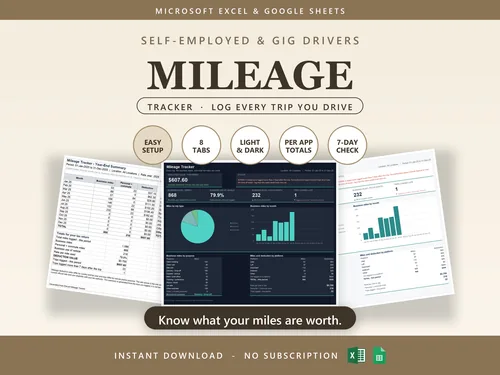
Mileage Tracker
The IRS expects a log written close to the time, kept for at least three years, and covering every vehicle separately. That is not a thing to hold in a tab you might close.
It keeps the year: every trip, several vehicles, the odometer readings, the business-use share and a dashboard that shows where the deduction stands before January arrives. It works in Excel and in Google Sheets, and nothing is locked behind a password.
Related
Mileage lowers the profit your tax is worked out on. To see what that profit means for your quarterly payments, use the Quarterly Estimated Tax Calculator.
Questions people ask
What is the IRS mileage rate for 2026?
There are two. Business driving is 72.5 cents a mile from 1 January to 30 June 2026, and 76 cents a mile from 1 July to 31 December. Charity stays at 14 cents, which is set by statute and rarely moves. Medical and active-duty military moving went from 20.5 cents to 23.5 cents at the same mid-year point. Because the business rate changed partway through, a single figure for the whole of 2026 will be wrong for roughly half your trips.
What does the IRS require a mileage log to contain?
Five things for each trip: the date, where you went from and to, the specific business reason for going, and the distance. On top of that, your odometer reading at the start and end of the tax year, which is how the share of business use is established. Records are expected to be written at the time or close to it, and kept for at least three years after you file.
Can I write up my mileage log at the end of the year?
You can, but it is the weaker position. Records made at or near the time of travel are what the rules expect, and a log that shows long gaps followed by bulk entries is more likely to be challenged. If you have no choice, back it up with whatever corroborates it: calendar entries, client emails, parking receipts, invoices that line up with the dates.
Is my commute deductible?
No. Travel between home and a regular workplace is personal, and it stays personal however much work you do on the way. Driving between two work locations, out to a client, to the bank or the post office for the business, or to a temporary site does generally count. If your home genuinely qualifies as your principal place of business, trips from it may count, but that test is strict.
Should I use the standard rate or actual expenses?
The standard rate is simpler and needs only a good log. Actual expenses means tracking every running cost and claiming the business-use share, which can be worth more on an expensive car. Give this page your running costs and it shows both. Note that the first year sets the rules: choosing actual expenses on a car you own generally locks that method in for that car, and a leased car put on the standard rate stays on it for the whole lease.
Can I claim parking and tolls as well?
Yes, and plenty of people forget. Business parking and tolls come on top of the mileage rate rather than being covered by it. There is a box for them above and they appear as their own line in the result.
Does this work in kilometres?
Yes. Switch the unit above and your entries are converted at 1 mile to 1.609344 kilometres before the rate is applied, because the IRS publishes per mile. The conversion is shown rather than hidden, so you can check it.
Does it store anything I type?
No. The calculator works out your numbers on your own device. Nothing you type is saved, sent to us or shared with anyone, so we have no way of seeing it. Close the page and it is gone. There is no sign-up and no email box. The CSV button builds the file on your own device, so the download goes straight to you.
How do I calculate mileage reimbursement?
Multiply the miles by the rate per mile. 120 business miles in March 2026 at the IRS rate of 72.5 cents is $87.00; the same miles in August, at 76 cents, are $91.20.
Your employer sets its own rate, and many use the IRS rate. Paid at or below that rate against a proper log, the reimbursement is not taxable income.
Federal law only requires reimbursement when unpaid driving costs would push your pay below the minimum wage. Some states, California and Illinois among them, require employers to reimburse work driving.
What was the IRS mileage rate in 2022?
2022 had two business rates: 58.5 cents a mile from January to June and 62.5 cents from July to December.
The rate table in this calculator starts at 2023, so for a 2022 trip multiply the miles by the rate for its date yourself.
Do Uber, Lyft and DoorDash miles count?
Yes. Rideshare and delivery drivers are self-employed, so the miles they drive for the work are business miles, deducted on Schedule C at the business rate.
The apps do not reimburse mileage; it comes off your taxes instead. Keep your own log rather than relying only on the app's yearly summary, which may not include every mile you drove for the work.
Can I deduct mileage as an employee?
Usually not. Since 2018, W-2 employees cannot deduct unreimbursed work mileage on their federal return, so the place to claim it is your employer's reimbursement policy.
A few groups still can, including Armed Forces reservists and qualified performing artists. Medical miles, at 20.5 cents for the first half of 2026 and 23.5 cents after, count only as part of itemized medical expenses above 7.5% of your income.