
Quarterly Estimated Tax Calculator
See what to send the IRS and when, based on the safe harbor that keeps you clear of the underpayment penalty.
Updated 30 October 2026. Rules checked 1 October 2026.
The Quarterly Estimated Tax Calculator is a free tool for freelancers, 1099 workers and anyone with income the IRS does not withhold from. It works out your 2026 federal tax, then the smallest amount you can pay in four installments without a penalty, and the dates each one is due.
- Both safe harbor routes, side by side. 90% of this year's tax, or 100% of last year's (110% above $150,000 of income). It marks the smaller one.
- Missed a payment? What to pay now, and roughly what being late has cost so far.
- Uneven income. If most of your money comes late in the year, the IRS lets early payments be smaller. It works that out too.
Whatever you type here is not saved or sent anywhere. We never see it, and it is gone when you close the page. This covers federal tax only: income tax and self-employment tax for 2026. State tax, the Additional Medicare Tax and the Net Investment Income Tax are not included.
What to pay
Next payment
The four 2026 due dates. Green is paid, ink is your withholding's share, red is overdue, amber is still to pay.
STACKED RUNGS · FEDERAL ONLY
The two routes, side by side
Equal payments or annualized
What each due date requires. Hollow is the equal 25% payment, ink is the annualized one worked from when you actually earned the money.
DUMBBELL · FORM 2210 SCHEDULE AI
Your 2026 payment dates
| Due | Required | Withholding counts | You paid | Overdue | To pay |
|---|
Pay at IRS Direct Pay and choose "estimated tax" and 2026, or through EFTPS. The 15 January 2027 payment can be skipped if you file your 2026 return and pay everything owed by 1 February 2027.
How much should I pay each quarter?
Enough to meet the safe harbor, and not necessarily your whole tax bill. The underpayment penalty is worked out against a required annual payment, which is the smaller of two figures: 90% of the tax on this year's return, or 100% of the tax on last year's. If last year's adjusted gross income was over $150,000 ($75,000 married filing separately), the second figure is 110%. Pay a quarter of the smaller one by each due date and there is no penalty, even if you owe more when you file.
Most calculators work out this year's tax and divide by four. That is one of the two routes, and it depends on predicting a year you have not finished. The prior-year route is already fixed. Here is the same freelancer both ways, single, with no other income:
| Figure | Each quarter | |
|---|---|---|
| 2026 profit $60,000, so 2026 tax | $12,037 | |
| Route 1: 90% of 2026 tax | $10,833 | $2,708 |
| Route 2: 100% of 2025 tax | $8,000 | $2,000 |
Paying $2,000 a quarter means $4,037 is still owed in April 2027, with no penalty on it, and that stays true whether 2026 turns out better or worse than expected.
What if I missed a payment?
Pay what is overdue as soon as you can. The penalty is not a flat fine. It is interest at the IRS underpayment rate, 7% a year for most of 2026 (6% from April to June), charged for each day each installment was late. Someone $500 short on each of the first three 2026 payments, paying it all on 1 October, has run up about $27. The calculator works this out from the dates and amounts you enter, using the IRS rate for each calendar quarter.
If you also have a job, there is a better fix. Federal tax withheld from wages counts as if it were paid evenly through the year, whenever it was actually withheld. Raising your withholding on a new W-4 for the rest of the year can cover quarters you already missed, which an estimated payment made late cannot.
Do I have to pay the same amount every quarter?
No. If your income is uneven, the IRS lets each payment follow what you had earned by then, using the annualized income installment method on Form 2210, Schedule AI. A seller who makes most of the year's profit between September and December can pay little or nothing in April and June and more in January. You claim it when you file, by attaching Schedule AI. Choose "Unevenly" above and enter what you earned in each IRS period to see both schedules.
Sources, checked 1 October 2026: the 2026 Form 1040-ES (tax rates, standard deduction, self-employment tax, safe harbor, due dates), Form 2210 and its Schedule AI, the IRS quarterly interest rates, and Rev. Proc. 2025-32 for the qualified business income threshold. The rate for January to March 2027 is not announced yet and is assumed to stay at 7%. This is arithmetic on the rules as published, not tax advice.
New to this? Start here
Who needs to pay. If you expect to owe $1,000 or more for 2026 after any tax withheld from a job, the IRS expects you to pay during the year rather than all at once in April. That covers most freelancers, 1099 contractors, gig drivers and online sellers with a profit of more than a few thousand dollars.
What you need. A rough figure for this year's profit, and your 2025 Form 1040 if you have it. Line 24 is your total tax and line 11 your adjusted gross income. Those two lines are what make the safe harbor work, so they are worth finding.
Reading the answer. The big number is what to pay next, or what to pay now if a date has passed. Under it are both safe harbor routes, with the one that asks less of you marked. The table further down gives all four dates.
What it includes. Federal income tax with the 2026 brackets and standard deduction, self-employment tax, and the qualified business income deduction, including the new $400 minimum. It does not include state tax, capital gains rates, the Additional Medicare Tax or the Net Investment Income Tax. If any of those apply to you, the real figure is higher.
Read more on tax for the self-employed: the estimated tax dates and the self-employment tax rate, and the templates for it.
The uneven-income method needs what you earned by each date. That is easy if every sale is already filed under its quarter.
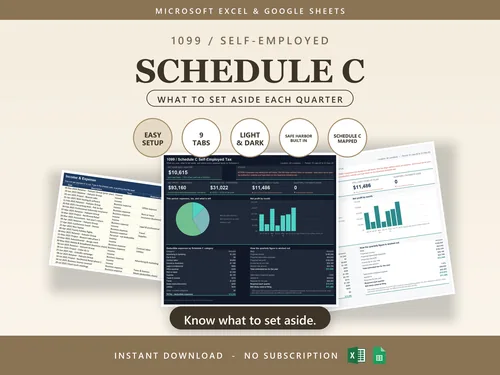
1099 / Schedule C Self-Employed Tax Spreadsheet
Every income and expense line records which quarter it counts toward, and the dashboard shows your net profit, the estimated tax on it and the quarterly payments made so far. When a due date comes round, the figures this calculator asks for are already there.
Schedule C Tax Spreadsheet, $3.80 on Etsy → What is inside it
Related
Mileage is often the biggest deduction a self-employed driver has: the Mileage Deduction Calculator applies the IRS rate for each trip date. Selling on Etsy? The Etsy Fee Calculator shows the profit left after fees, which is the figure this tool taxes. And if you are working out what to charge, the Freelance Rate Calculator builds the tax into the rate.
Questions people ask
How much should I pay each quarter?
A quarter of your required annual payment, which is the smaller of 90% of your 2026 tax and 100% of your 2025 tax (110% if your 2025 adjusted gross income was over $150,000). Tax withheld from a job counts toward it. Paying that much by each due date avoids the underpayment penalty even if you owe more when you file.
When are the 2026 estimated tax payments due?
15 April 2026, 15 June 2026, 15 September 2026 and 15 January 2027. The periods are not equal: the second payment covers two months and the last covers four. You can skip the January payment if you file your 2026 return and pay everything owed by 1 February 2027.
I missed a quarterly payment. What should I do?
Pay the overdue amount as soon as you can. The penalty is interest at the IRS underpayment rate, 7% a year for most of 2026, charged per day late on each short installment, so it stops growing once you pay. If you have a job, raising your withholding for the rest of the year can cover the missed quarters, because withholding counts as paid evenly through the year.
Do I have to pay the same amount each quarter?
No. If your income comes unevenly, the annualized income installment method on Form 2210, Schedule AI, lets each payment follow what you had earned by that date. Someone who earns most of their profit late in the year can pay less in April and June. You attach Schedule AI to your return to use it.
Do I need to pay estimated tax if I have a W-2 job?
Only if you expect to owe $1,000 or more after the tax withheld from your wages. If you do, you can either make estimated payments or increase your withholding with a new Form W-4. Withholding is treated as paid evenly through the year, so it is often the simpler fix.
Does this include state tax?
No. It covers federal income tax and self-employment tax only. Most states with an income tax have their own estimated payments with their own rules and dates.
How much tax do I pay on 1099 income?
Two taxes: self-employment tax for Social Security and Medicare, and ordinary income tax. On $60,000 of 1099 profit in 2026, filing single with no other income, the self-employment tax is $8,477.73 and the federal income tax is $3,559.47, so $12,037.20 in all, about 20% of the profit.
Paid in four equal installments that is about $3,009 each quarter. Your own figure depends on your filing status, other income and deductions, which is what the calculator above takes into account.
What is the self-employment tax rate?
15.3%: 12.4% for Social Security and 2.9% for Medicare. It applies to 92.35% of your net profit, and only once your net earnings from self-employment reach $400. Half of it is deducted when your income tax is worked out, which the calculator does for you.