
No Tax on Overtime Calculator
Work out the overtime deduction the way the IRS does, see what it saves you, and check the figure on your W-2.
Updated 30 October 2026. Rules checked 1 October 2026.
The No Tax on Overtime Calculator is a free tool for the federal overtime deduction, which runs from 2025 to 2028. Only part of your overtime counts: the extra half of time-and-a-half, on hours over 40 in a week. It works that out, takes off the cap and the income phase-out, and tells you what it is worth in tax.
- The real figure, not total overtime divided by three. Daily overtime, union overtime from 35 hours and double time are each counted only as far as federal law requires.
- A W-2 check. From 2026 only the amount in box 12 code TT can be deducted. Compare it with what it should be.
- Money now. The figure for your W-4, and what it adds to each paycheck.
Whatever you type here is not saved or sent anywhere. We never see it, and it is gone when you close the page. This covers federal income tax only. Social Security, Medicare and state income tax are not changed by this deduction.
Your deduction
Overtime deduction
Example: saves about $317 in federal income tax at 12%
From qualified overtime to the deduction, then what it saves. Red is anything the cap or the income limit takes off.
RUNG WATERFALL · FEDERAL INCOME TAX ONLY
Week by week
Hours in each week against the federal 40. Amber counts toward the deduction. Red is overtime your employer pays that federal law does not require, so it does not count.
STACKED RUNGS · ONE RUNG = ONE HOUR
| Week | Hours | Regular rate | Federal overtime | Employer-only overtime | Qualified pay |
|---|
Your W-2 and your W-4
How big is the deduction, by hourly rate and overtime hours
The deduction is the extra half of time and a half, not your whole overtime pay: half your regular rate for each overtime hour. The table assumes the same overtime every week for 50 weeks. At $20 an hour and 5 overtime hours a week, that is $50 a week, or $2,500 for the year.
| Hourly rate | 2 overtime hours a week | 5 overtime hours a week | 10 overtime hours a week | 15 overtime hours a week |
|---|---|---|---|---|
| $15 | $750 | $1,875 | $3,750 | $5,625 |
| $20 | $1,000 | $2,500 | $5,000 | $7,500 |
| $25 | $1,250 | $3,125 | $6,250 | $9,375 |
| $30 | $1,500 | $3,750 | $7,500 | $11,250 |
| $35 | $1,750 | $4,375 | $8,750 | $12,500 (cap) |
| $40 | $2,000 | $5,000 | $10,000 | $12,500 (cap) |
| $45 | $2,250 | $5,625 | $11,250 | $12,500 (cap) |
| $50 | $2,500 | $6,250 | $12,500 | $12,500 (cap) |
This is the deduction, not the tax it saves; the calculator above works out the saving at your rate. The cap is $12,500 a year, or $25,000 on a joint return, and the deduction shrinks above $150,000 of income ($300,000 joint). Only overtime federal law requires counts.
Why most calculators get this wrong
The rule is narrower than the name. The deduction covers qualified overtime compensation, which the IRS defines as the overtime pay federal law requires, above your regular rate. Federal law, the Fair Labor Standards Act, requires time-and-a-half for hours over 40 in a workweek. So for each of those hours, the deductible part is half your regular rate. You still pay tax on the straight-time part.
If all your overtime is time-and-a-half after 40 hours, that half is a third of your overtime pay, and dividing by three works. That is the shortcut every other free calculator uses. It stops working the moment your overtime is anything else:
| Worker, $20 an hour | The week | Overtime pay | Divide by three | What counts |
|---|---|---|---|---|
| Dana, California | Four 10-hour days | $240 | $80 | $0 |
| Luis, union contract | 45 hours, overtime from 35 | $300 | $100 | $50 |
| Kim, double time | 45 hours, all over 40 at 2x | $200 | $67 | $50 |
Dana worked 40 hours, so federal law owed no overtime at all, even though California did. Luis's first five overtime hours came before 40. Kim's employer paid a full extra rate where the law asks for half. None of them is underpaid. Their pay follows their employer's rules, and the deduction follows the federal one, so the two come apart.
The other thing that changed is where the number comes from. For 2025, employers did not have to report it, so people worked it out from pay stubs. From 2026, your employer must put it on your W-2 in box 12 with code TT, and that is the only figure you can deduct. If it looks low, the fix is a corrected W-2 from your employer, called a W-2c. Doing your own estimate on the return does not work any more, and neither does a substitute W-2 (IRS FS-2026-13, questions 20 to 23).
A bonus or a shift differential works the other way. It raises your regular rate for the week, so the deductible half is bigger than your base rate suggests. The week by week option counts it.
Sources, checked 1 October 2026: IRS fact sheet FS-2026-13, IRS Notice 2025-69, Schedule 1-A lines 14 to 21, the 2026 Form W-4, and the 2026 Form 1040-ES rate schedules. Whether your job is owed overtime at all is set by the Department of Labor: see Fact Sheet #14. This is arithmetic on the rules as published, not tax advice.
New to this? Start here
First, check you qualify. You need to be an hourly or salaried employee who is owed overtime under federal law. If you are paid a salary and never get overtime, or you are a contractor on a 1099, this deduction is not for you. Married couples have to file a joint return to claim it, and you need a Social Security number valid for work.
Then pick how to start. A typical week is quickest: your rate, the hours over 40 in a normal overtime week, and how many weeks like that you work. A pay stub total is good for 2025 returns or a quick check. Week by week is the one to use if your overtime starts daily, before 40 hours, or at double time, because it separates the hours that count from the ones that do not.
Income only matters if it is high. The deduction shrinks above $150,000 of income, or $300,000 on a joint return, by $100 for every full $1,000 over. Below that, leave the box empty.
The answer. The big number is your deduction, after the $12,500 cap ($25,000 joint). Under it is roughly what that saves in federal income tax. Below the tool, put in your W-2 code TT figure when it arrives to check it, and see the number to put on a new W-4 if you want the money in your paychecks now.
Read more on tax for the self-employed: the estimated tax dates and the self-employment tax rate, and the templates for it.
The W-2 check only works if you know your own weeks. Most people have nothing but pay stubs.
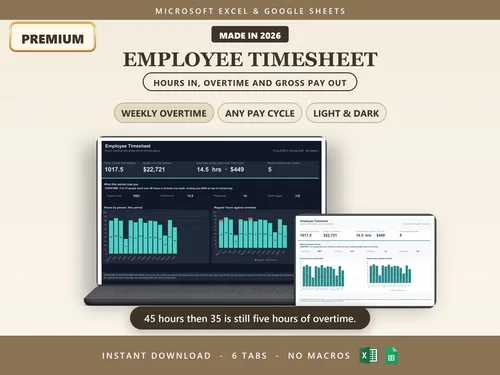
Employee Timesheet
Log your hours as you work them and every week is settled on its own, with overtime split out. At the end of the year you have your own record of the hours over 40 to hold the W-2 figure against, rather than a guess.
Related
To check what your overtime should pay in the first place, including bonuses and a second pay rate, use the Overtime Calculator. To total a week from clock-in and clock-out times, use the Time Card Calculator.
Questions people ask
Is all my overtime tax free?
No. The deduction covers only the extra half of time-and-a-half that federal law requires, on hours over 40 in a workweek. The straight-time part of every overtime hour is still taxed. It is also a deduction from federal income tax only: Social Security, Medicare and state income tax are worked out as before.
Does double time count?
Only part of it. If you are paid double time on hours over 40, the deduction still covers half your regular rate for each of those hours, which is what federal law requires. The rest is extra your employer chose to pay. From a pay stub total of double time pay, that comes to a quarter of the total.
Does California daily overtime count?
Only where it is also federal overtime. Federal law counts hours over 40 in the workweek and has no daily rule. Four 10-hour days earn 8 hours of California overtime and zero federal overtime, so none of that premium is deductible. Overtime that starts at 35 hours under a union contract works the same way: only the hours over 40 count.
Can I deduct more than the figure in box 12 code TT on my W-2?
Not for 2026 or later. From tax year 2026 the deduction can only use the amount your employer reports in Form W-2 box 12 with code TT. If you think that figure is too low, ask your employer for a corrected W-2, which is Form W-2c. A substitute W-2 on Form 4852 is not accepted for this. For 2025 only, you could work the figure out yourself from your pay stubs.
Can I get the money in my paycheck instead of waiting for a refund?
Yes. The 2026 Form W-4 has a line for it: Step 4(b), deductions worksheet line 1b, qualified overtime compensation. Give your employer a new W-4 with your estimate there and less tax is withheld from each remaining paycheck. Nothing changes until you do.
Who cannot claim it?
Anyone not owed overtime under federal law, which includes most salaried exempt staff and independent contractors. Married people filing separately cannot claim it; married couples must file jointly. You also need a Social Security number valid for work, and an owner with a 20 percent or larger stake who helps run the business generally does not qualify.
How much will no tax on overtime save me?
The deduction times your tax bracket. At $20 an hour with 5 overtime hours a week for 50 weeks, the deduction is $2,500. In the 12% bracket that saves $300 of federal income tax; in the 22% bracket, $550.
It is a deduction, not a refund of the overtime tax, and it does not reduce Social Security or Medicare. The most it can be is $12,500, or $25,000 on a joint return.
Is overtime taxed more than regular pay?
No. Overtime is income taxed at the same rates as the rest of your pay. A paycheck with overtime can look more heavily taxed because payroll withholds as if you earned that much every period, which can push part of it into a higher bracket for that one check.
The real tax is settled on your return, where any over-withholding comes back.
How do I calculate qualified overtime?
Count only the extra half of time and a half. For every hour over 40 in a week, qualified overtime is half your regular rate.
At $20 an hour with 46 hours worked, the overtime pay is 6 hours at $30, or $180, but the qualified part is 6 times $10, which is $60. Shift differentials and nondiscretionary bonuses raise your regular rate, and so raise that half.
Does no tax on overtime apply to salaried employees?
Only if you are owed overtime under federal law. Exempt salaried employees, who are not paid overtime, have nothing to deduct.
Non-exempt salaried employees who are paid overtime do qualify. Their regular rate is the weekly salary divided by the hours it is meant to cover, and the deduction is half of that rate for each hour over 40.