
Personal Finance & Budgeting
For households running their money out of a checking account and a rough idea. Budgets that survive contact with a real month, bills you can see coming, and a debt plan that names the payoff date. Nothing to subscribe to, and the file stays yours.
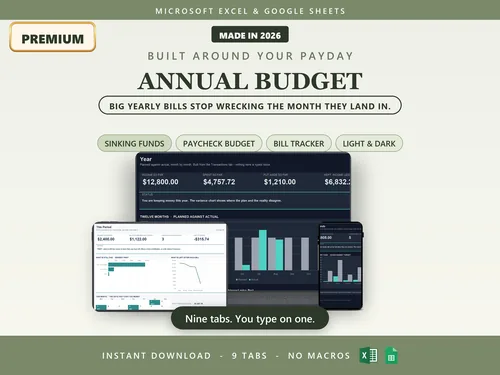
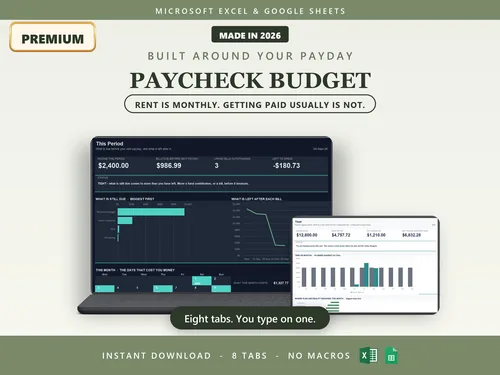
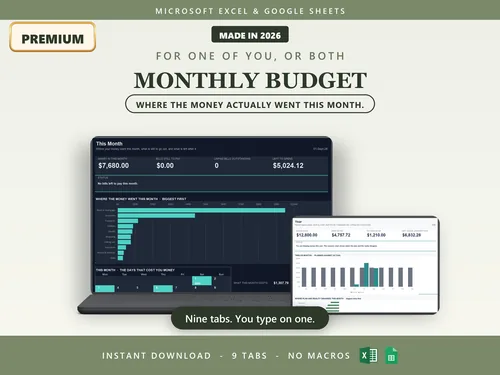
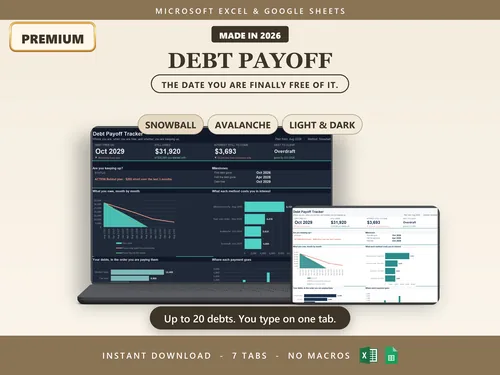
Carrying debt? The free debt payoff calculator gives you a debt-free date in your browser before you buy anything. The Debt Payoff Tracker does the same sum inside a file you keep.
The templates side by side
Every one works in Excel and Google Sheets. "You type into" counts the tabs where your numbers go; "calculated for you" counts the tabs that need no typing at all, and "set up once" the tabs you fill in at the start.
| Template | Tabs | You type into | Calculated for you | Set up once | Price |
|---|---|---|---|---|---|
| Annual Budget Spreadsheet | 9 | 4 | 3 | 2 | $3.29 |
| Paycheck Budget Spreadsheet | 8 | 4 | 2 | 2 | $2.99 |
| Monthly Budget Spreadsheet | 9 | 4 | 3 | 2 | $2.99 |
| Debt Payoff Tracker | 7 | 3 | 2 | 2 | $3.29 |
Which template do I need?
If the question is "where did it actually go?", a monthly budget holding the spending, the bills and the money set aside for later is the one to start with. It logs transactions once and builds the month, the year and the funds from them.
Paid weekly or every two weeks, budgeting to your payday rather than the calendar month lines each bill up with the pay period it actually falls in. Planning a whole year at once is the annual budget instead.
Carrying several balances, a payoff month calculated from your real rates puts snowball and avalanche side by side and shows what one extra payment a month buys, before you commit to either.
Where to start with a budget
A common starting point is the 50/30/20 split: about half of take-home pay to needs, 30% to wants and 20% to savings and debt repayment. It is a rough guide rather than a rule, and in a high-rent year needs will take more than half.
Bills that come once or twice a year are where most budgets break. Setting a little aside each month for them, in what budgeters call sinking funds, turns a $600 car insurance renewal into $50 a month that has already happened.
If debt is the bigger question, the free debt payoff calculator gives you a debt-free month and the interest it costs, for snowball and avalanche side by side.