
Overtime Calculator
Work out time and a half for every week in your pay period, including the overtime that adding the weeks together would have hidden.
Updated 30 October 2026.
Only have clock-in and clock-out times? The time card calculator adds up the week first. To see what your overtime is worth at tax time, the no tax on overtime calculator works out the federal deduction.
This is a free overtime calculator that works out time and a half pay from your hourly rate and the hours you worked. At $20 an hour, overtime pays $30 an hour, so 6 hours over 40 add $180 to the week. It settles each week on its own, which is how overtime is owed, and handles double time, a second pay rate and bonuses.
- One week at a time. A busy week and a quiet week do not cancel out.
- Blended rates. A bonus or a second rate lifts the rate overtime is paid on.
- Your rules. Weekly threshold, multiplier, and optional daily and double-time limits.
What is owed
Gross pay for the period
Example: 80 hours across 2 weeks
Hours in each week. Everything above the red line is paid at the higher rate, week by week, whatever the week beside it did.
STACKED RUNGS · ONE RUNG = ONE HOUR
Week by week
| Week | Hours | Regular rate | Normal hours | Overtime hours | Premium | Week total |
|---|
This is gross pay, before tax and any other deduction. It follows the thresholds you set above and knows nothing about where you are. It cannot tell you whether someone is entitled to overtime, which depends on their job and their contract rather than their hours. The rules this follows are the federal ones: overtime after 40 hours in a workweek, at least time and a half on the regular rate, and no averaging across weeks (U.S. Department of Labor, Fact Sheet #23 and Overtime Pay).
Overtime pay at time and a half, by hourly rate
Time and a half is your hourly rate multiplied by 1.5. At $16 an hour that is $24 for each overtime hour, so five hours of overtime pays $120 on top of your regular pay. Find your rate below.
| Hourly rate | Time and a half | 5 overtime hours | 10 overtime hours | Double time |
|---|---|---|---|---|
| $10.00 | $15.00 | $75.00 | $150.00 | $20.00 |
| $11.00 | $16.50 | $82.50 | $165.00 | $22.00 |
| $12.00 | $18.00 | $90.00 | $180.00 | $24.00 |
| $13.00 | $19.50 | $97.50 | $195.00 | $26.00 |
| $14.00 | $21.00 | $105.00 | $210.00 | $28.00 |
| $15.00 | $22.50 | $112.50 | $225.00 | $30.00 |
| $16.00 | $24.00 | $120.00 | $240.00 | $32.00 |
| $17.00 | $25.50 | $127.50 | $255.00 | $34.00 |
| $18.00 | $27.00 | $135.00 | $270.00 | $36.00 |
| $19.00 | $28.50 | $142.50 | $285.00 | $38.00 |
| $20.00 | $30.00 | $150.00 | $300.00 | $40.00 |
| $21.00 | $31.50 | $157.50 | $315.00 | $42.00 |
| $22.00 | $33.00 | $165.00 | $330.00 | $44.00 |
| $23.00 | $34.50 | $172.50 | $345.00 | $46.00 |
| $24.00 | $36.00 | $180.00 | $360.00 | $48.00 |
| $25.00 | $37.50 | $187.50 | $375.00 | $50.00 |
| $26.00 | $39.00 | $195.00 | $390.00 | $52.00 |
| $27.00 | $40.50 | $202.50 | $405.00 | $54.00 |
| $28.00 | $42.00 | $210.00 | $420.00 | $56.00 |
| $29.00 | $43.50 | $217.50 | $435.00 | $58.00 |
| $30.00 | $45.00 | $225.00 | $450.00 | $60.00 |
| $31.00 | $46.50 | $232.50 | $465.00 | $62.00 |
| $32.00 | $48.00 | $240.00 | $480.00 | $64.00 |
| $33.00 | $49.50 | $247.50 | $495.00 | $66.00 |
| $34.00 | $51.00 | $255.00 | $510.00 | $68.00 |
| $35.00 | $52.50 | $262.50 | $525.00 | $70.00 |
| $36.00 | $54.00 | $270.00 | $540.00 | $72.00 |
| $37.00 | $55.50 | $277.50 | $555.00 | $74.00 |
| $38.00 | $57.00 | $285.00 | $570.00 | $76.00 |
| $39.00 | $58.50 | $292.50 | $585.00 | $78.00 |
| $40.00 | $60.00 | $300.00 | $600.00 | $80.00 |
| $41.00 | $61.50 | $307.50 | $615.00 | $82.00 |
| $42.00 | $63.00 | $315.00 | $630.00 | $84.00 |
| $43.00 | $64.50 | $322.50 | $645.00 | $86.00 |
| $44.00 | $66.00 | $330.00 | $660.00 | $88.00 |
| $45.00 | $67.50 | $337.50 | $675.00 | $90.00 |
| $46.00 | $69.00 | $345.00 | $690.00 | $92.00 |
| $47.00 | $70.50 | $352.50 | $705.00 | $94.00 |
| $48.00 | $72.00 | $360.00 | $720.00 | $96.00 |
| $49.00 | $73.50 | $367.50 | $735.00 | $98.00 |
| $50.00 | $75.00 | $375.00 | $750.00 | $100.00 |
Gross pay, before tax. If you earned a bonus or worked at a second rate in the same week, the overtime rate is higher than this table shows; the calculator above works that out.
New to this? Read a short explanation first
Overtime looks simple until you run a biweekly payroll. The rule most places start from is that anything past forty hours in a single week is paid at a higher rate, usually one and a half times the normal one.
The word doing the work there is week. Overtime is settled one week at a time, even when you pay people every two weeks or monthly. Someone who works fifty hours one week and thirty the next has done eighty across the two weeks, which looks like no overtime at all. It is not. They are owed ten hours of overtime for the busy week, and the quiet week does not cancel it out. Adding the weeks together first is the single most common way a pay run goes wrong.
The second thing worth knowing is that overtime is not always based on the hourly rate written on the contract. If someone earned a bonus that week, or worked some of their hours at a different rate, the fair rate for overtime is an average of everything they earned that week, worked out before the premium is applied. Payroll people call it the regular rate. It is usually a little higher than the base rate, and missing it quietly underpays every overtime hour.
So: one week per row, the hours and the rate for that week, and a bonus if there was one. The thresholds below start at the common defaults and you can change them, because some countries and some states count overtime by the day as well as by the week.
One honest limit. This works out gross pay, which is the figure before tax and any other deduction comes off. It does not know your country, and it cannot decide whether someone is entitled to overtime in the first place.
Read more on hours, overtime and leave: what federal law asks of an employer, and the templates for it.
The Overtime Calculator above settles one pay run. Something has to hold the hours.
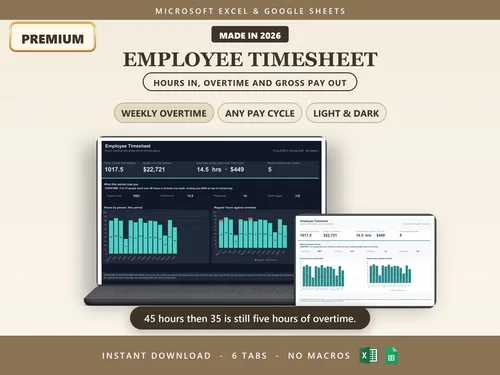
Employee Timesheet
A calculator answers the question for the period in front of you. What it cannot do is remember last month, keep a running leave balance, or tell you who is drifting toward overtime before the week ends.
It keeps the hours themselves, with the same week-by-week logic built into the sheet. The Attendance and PTO Tracker handles the leave side, and the Team and Time Pack is both together. All of them work in Excel and in Google Sheets.
Questions people ask
Do I need this or the time card calculator?
It depends on what you have in front of you.
- Use this one if you already know the hours for each week and want to know what they pay. It is also the one to use when a bonus or a second pay rate is involved, because those change the rate overtime is paid at.
- Use the time card calculator if all you have is clock-in and clock-out times. It adds up each day, takes off unpaid breaks, handles shifts that run past midnight, and shows what rounding your punches costs over a year.
Both follow the same overtime rules, weekly and daily, so either one will tell you when overtime starts.
Why does adding the two weeks together give a different answer?
Because overtime is owed by the week, not by the pay period. Fifty hours one week and thirty the next is eighty hours in total, which looks like nothing owed. In fact ten hours of overtime were earned in the busy week, and the quiet week does not offset them. Adding the weeks first is the most common payroll error there is, and it always underpays.
What is a blended or regular rate?
It is the average rate someone actually earned in a week, worked out by dividing everything they earned that week by the hours they worked. When a week includes a bonus or hours at two different rates, the overtime premium is properly paid on that average rather than on the contract rate. It is usually slightly higher, so using the contract rate underpays every overtime hour.
Does a bonus really change overtime pay?
A bonus promised in advance for hitting a target, an attendance record or an output figure generally does. It counts as part of what was earned that week, so it lifts the average rate the overtime premium is based on. A genuine surprise gift generally does not. If you are unsure, including it is the safer side to be wrong on.
Why is there no country setting?
Because rules change and a rate baked into a page goes stale quietly. Every threshold here is yours to set, which means the tool never needs an annual update and never tells you something that stopped being true last April. The defaults match the most common arrangement, and you can change any of them.
Does it handle daily overtime and double time?
Yes, as optional settings that are off by default. Some places count overtime once a single day runs long, whatever the weekly total, and some add a second limit past which hours pay double. Fill those two boxes only if your rules work that way.
Is this gross or take-home pay?
Gross, which is the figure before income tax, Social Security, Medicare, retirement contributions or any other deduction. What actually reaches someone's bank account depends on their tax position, which this page knows nothing about and does not ask.
How much is overtime at $16 an hour?
$24 an hour, which is $16 times 1.5. Five overtime hours in a week come to $120 on top of regular pay, and ten come to $240.
The overtime pay table on this page lists the same figures for every hourly rate from $10 upward.
How do I calculate overtime pay by hand?
Multiply your hourly rate by 1.5, then by the overtime hours. Under federal law, overtime is every hour over 40 in a single workweek.
At $20 an hour with 46 hours worked, the 40 regular hours pay $800 and the 6 overtime hours at $30 pay $180, so the week pays $980.
Work each week out separately. Two weeks of 46 and 34 hours contain 6 overtime hours, even though the pay period adds up to exactly 80.
How is 30 minutes of overtime paid?
As half an hour at time and a half. At $20 an hour the overtime rate is $30, so 30 minutes is $15.
Overtime is counted in minutes, not only whole hours. Employers may round clock times to the nearest quarter hour, but only if the rounding evens out over time rather than always going against you.
Do 12-hour shifts get overtime?
Under federal law, only once the week goes over 40 hours. Three 12-hour shifts are 36 hours, so no overtime; four are 48 hours, so 8 of them are overtime.
Some states add daily overtime. In California, hours over 8 in a day are paid at time and a half and hours over 12 at double time, so a single 12-hour shift there includes 4 overtime hours. Hospitals and nursing homes may instead use an 8 and 80 system, with overtime after 8 hours in a day or 80 in two weeks, where staff have agreed to it.
You can set daily overtime and double time rules in the calculator above.