
Freelance Rate Calculator
Work back from the income you want to keep to the rate that gets you there, counting only the hours a client actually pays for.
Updated 30 October 2026.
This is a free freelance rate calculator that works backwards from what you want to take home. It adds your expenses, grosses up for tax, and divides by the hours you genuinely bill rather than the hours you work, which is where most rates are set far too low.
- Starts from take-home. Not the figure you invoice.
- Counts billable hours only. The hours nobody pays for still have to be paid for.
- Shows the common mistake. What dividing by 2,080 would have given you.
What you need to charge
Your hourly floor
Example: 1,104 billable hours a year, out of 1,840 worked
Where every hundred dollars you invoice ends up.
TICK DONUT · ONE TICK = ONE PERCENT OF WHAT YOU INVOICE
How the rate moves with the hours you bill
The rate you need at every share of hours billed. The dashed line is what dividing by 2,080 hours would have told you.
HAIRLINE LINE · SHARE OF HOURS BILLED, 30 TO 90 PERCENT
| Share of hours billed | Billable hours a year | Rate you would need | Against your figure |
|---|
Where the money goes
A planning figure, not tax advice. The tax rate is the one you supply, and a real bill depends on where you live, how you are set up and what you can deduct. It also assumes you fill the billable hours you entered, which in a slow quarter you may not.
New to this? Read a short explanation first
Most people work out a freelance rate by taking the salary they would like and dividing it by 2,080, the number of working hours in a year. The figure that comes out is almost always too low, and the reason is simple: nobody bills every hour they work.
Time goes on proposals that never land, invoicing, email, bookkeeping, learning the thing you were hired for, and finding whoever comes next. For most freelancers somewhere between half and two thirds of working hours are actually charged to a client. If you set a rate as though all of them are, you have quietly built in a shortfall you will feel every month without understanding why.
Tax is the other half of the gap. An employee sees a salary after tax has already gone. A freelance rate has to cover what you keep, what the business costs to run, and what goes to the tax office, all from the same number.
So start from what you want to end up with, not what you want to invoice. Add what running the business costs you over a year. Put in a rough tax rate. Then be honest about how many hours a week you genuinely bill, which for most people is a good deal fewer than the hours they work.
The rate this gives you is a floor rather than a price list. It is the number below which the year does not work. What you actually charge a particular client can sit well above it.
Read more on invoicing and clients: what an invoice needs to say, and the templates for it.
The Freelance Rate Calculator above sets the rate. Something has to collect it.
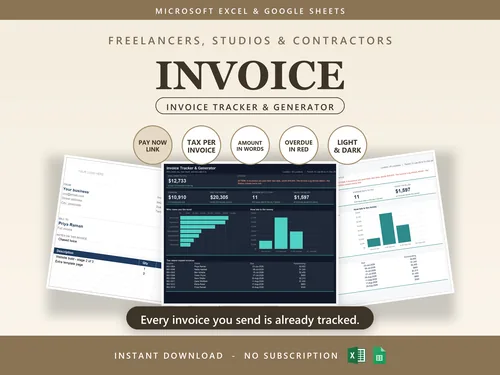
Invoice Tracker & Generator
A rate is the easy half. The hard half is a year of remembering who was quoted what, which invoice went out in March, who has paid and who is politely ignoring you.
It keeps that side: what is out, what is overdue, and how long each client really takes to pay. The Client Tracker and CRM holds the relationships behind it, and the Get Paid Pack is the two together. Excel and Google Sheets, nothing locked.
Invoice Tracker & Generator, $2.99 on Etsy → What is inside it
Related
A freelance rate has to cover the tax, and the IRS wants that tax during the year, not all in April. The Quarterly Estimated Tax Calculator shows how much to send each quarter to stay clear of the penalty.
Questions people ask
Why is my rate so much higher than my old salary divided by 2,080?
Because an employee is paid for vacation, holidays, sick days, training and every hour spent in a meeting that billed nobody. A freelancer is paid only for the hours a client accepts. Once you take out the unbilled time, add the costs an employer used to cover, and gross up for tax, the number roughly doubles. That is not greed. It is the same income, priced honestly.
What is a realistic share of hours to bill?
Most freelancers land between 50 and 70 percent. Newer ones are often nearer 40, because they spend more time finding work than doing it. Established people with a couple of retainer clients reach the upper end. If you have never measured it, start at 60 and adjust once you have watched a month go by.
What counts as a business cost?
Anything you pay because the business exists rather than because you do. Software subscriptions, a laptop, professional insurance, an accountant, a coworking desk, industry membership, courses. Not your rent or your groceries, which the take-home figure is meant to cover.
Should I use my top tax bracket?
No, use the effective rate: the share of everything you earn that actually leaves you across the year, once the standard deduction and the lower brackets are taken into account. It is always lower than the top bracket. Include self-employment tax, since those are real and easy to forget.
Is this the rate I should quote?
It is the floor, not the price. Below it the year does not work. Above it is where value, scarcity and how much the job is worth to the client all come in. Plenty of good work is priced by the project rather than the hour, and this number is what tells you whether a project price is worth taking.
Does it store anything I type?
No. The calculator works out your numbers on your own device. Nothing you type is saved, sent to us or shared with anyone, so we have no way of seeing it. Close the page and it is gone. There is no sign-up and no email box on this page.